ML Training & AutoML
Classification, regression, clustering, dimensionality reduction, and AutoML — 76 algorithms with cross-validation.
On this page
Supported algorithms#
- Classification: Logistic Regression, Random Forest, XGBoost, LightGBM, CatBoost, SVM, KNN, Naïve Bayes, Decision Tree, Extra Trees, AdaBoost, MLP
- Regression: Linear, Ridge, Lasso, ElasticNet, Random Forest, Gradient Boosting, XGBoost, SVR, KNN
- Clustering: K-Means, DBSCAN, Hierarchical, Gaussian Mixture, Spectral, Mean-Shift
- Dimensionality reduction: PCA, kernel PCA, truncated SVD, t-SNE, UMAP, ICA, factor analysis
- Time series: ARIMA (order chosen automatically or set by hand), SARIMA, exponential smoothing (simple, Holt, damped Holt, Holt-Winters), Prophet, random forest on lagged values
- Forecasting with predictors and with uncertainty: SARIMAX (a regression on other columns with ARIMA errors), XGBoost on lagged values and predictors, and quantile forecasts scored on the held-out window
- Anomaly detection: isolation forest, one-class SVM, local outlier factor, elliptic envelope
- Association rules: Apriori and FP-Growth for market-basket style mining
- Ensembles: bagging, stacking, and hard / soft voting over your trained models
- AutoML: trains and tunes a slate of models with Optuna, returns a ranked leaderboard
Tuning & data handling#
- Hyperparameter search: grid, random, and Bayesian (Optuna)
- Class imbalance: SMOTE, ADASYN, under-sampling, and class weighting
- Feature selection: k-best and recursive feature elimination (RFE)
- Probability calibration: Platt scaling and isotonic regression
Evaluation#
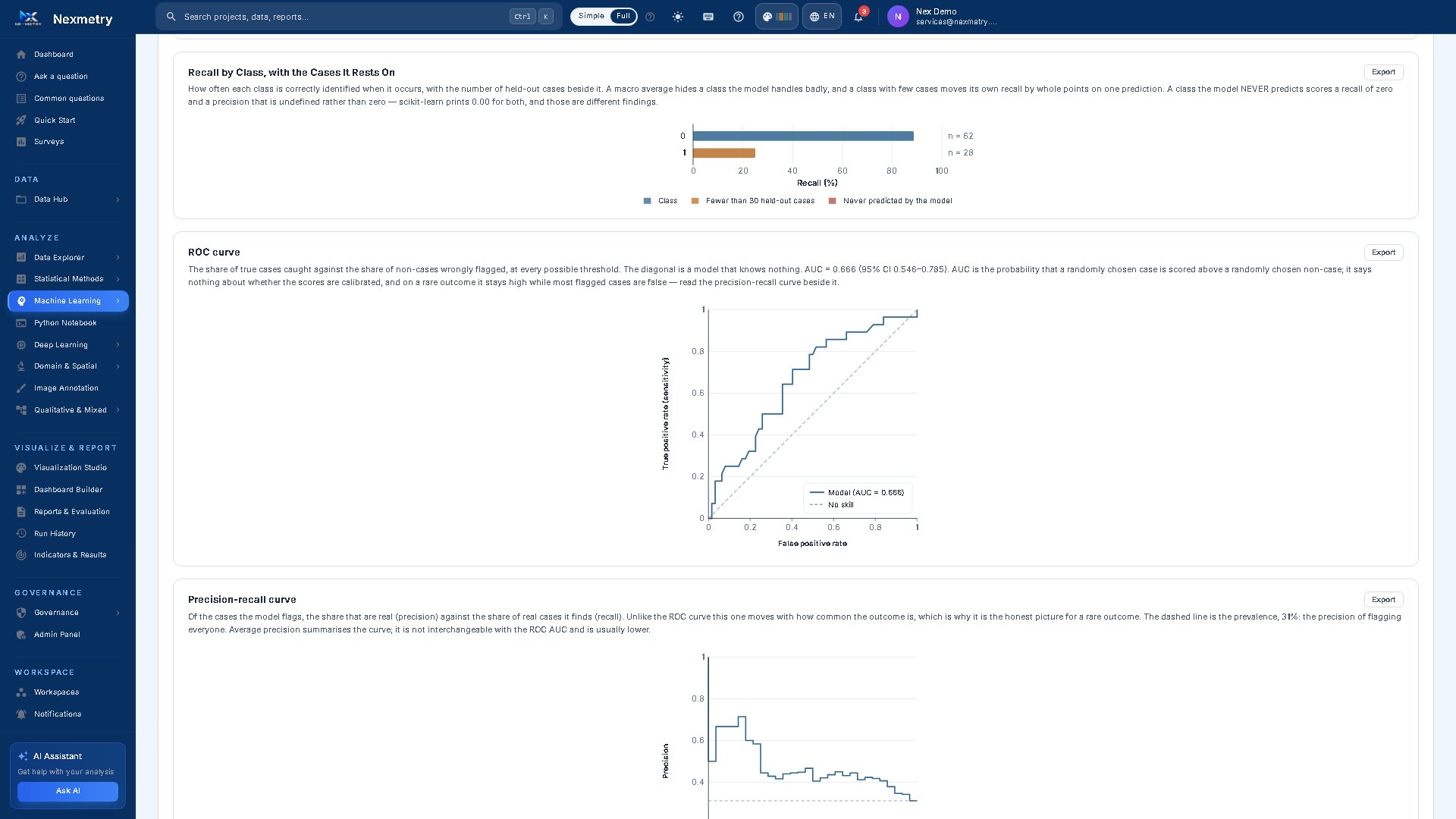
- Classification: confusion matrix, ROC/PR curves, calibration, SHAP values
- Regression: residual plots, RMSE/MAE/R², feature importance
- Cross-validation: k-fold, stratified, grouped, time-series split
- Fairness: subgroup performance and disparity metrics across protected attributes
- Drift detection on inputs and predictions once a model is in use
- Leakage checks that flag target leakage before you trust a score
Long runs: time left and a notification#
While a model trains, the progress bar says about how long is left. Before the first progress arrives it says how long a run usually takes for data this size, from your earlier runs in this browser.
Press Tell me when it’s done and allow notifications in your browser. If training takes more than half a minute and you are in another tab or window, a notification says when it has finished or stopped, and the tab title shows ✓ or !.
Something missing?
Have a question these docs don’t answer? Email support@nexmetry.org and we’ll add a guide.